Navigation
Narrative
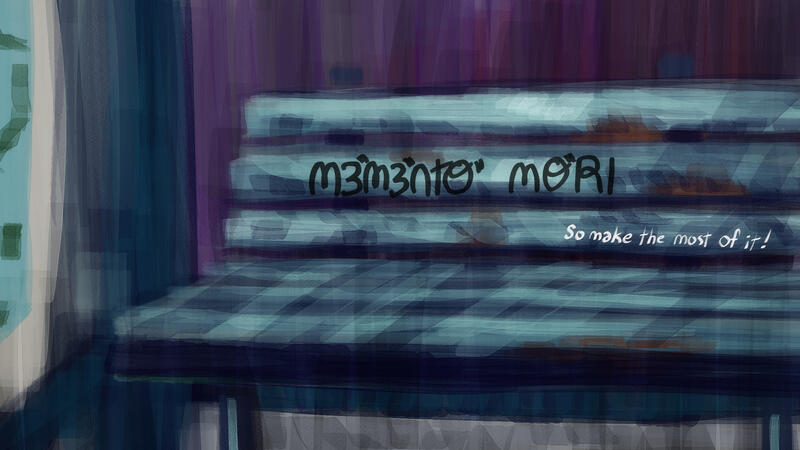
Beatboard Panel 1
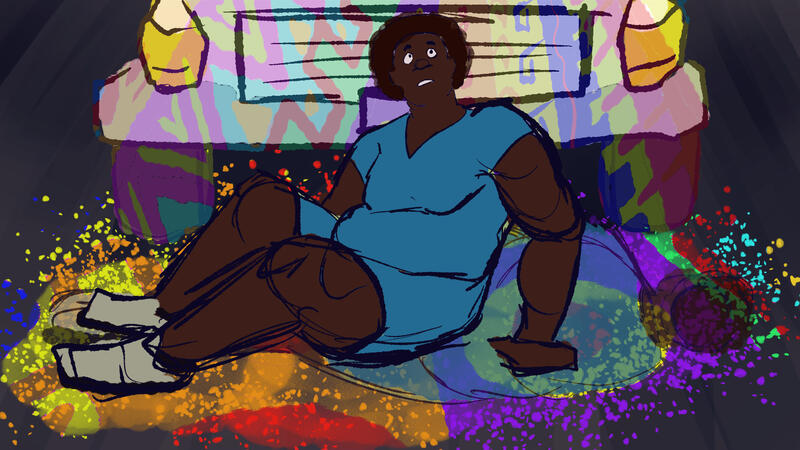
Beatboard Panel 2
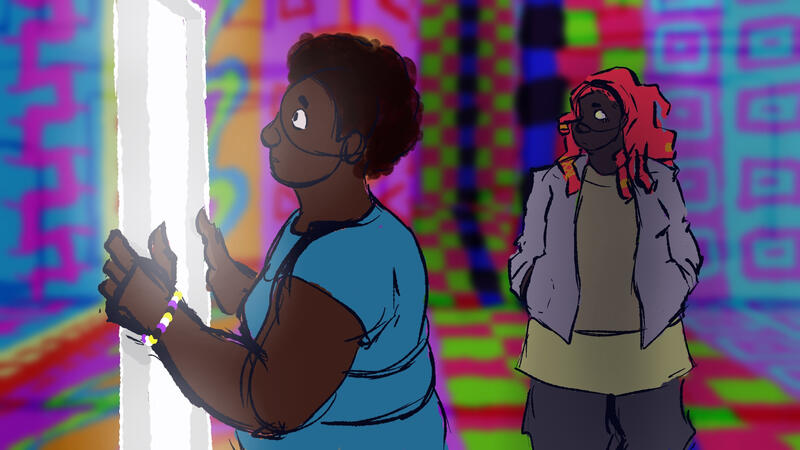
Beatboard Panel 3
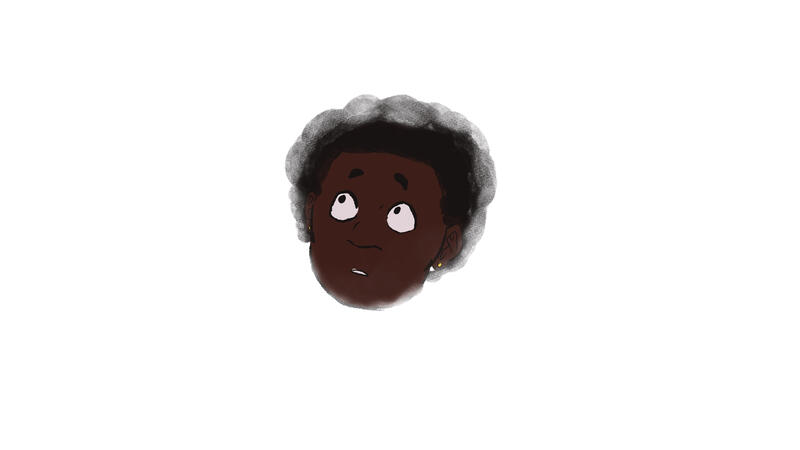
Beatboard Panel 4
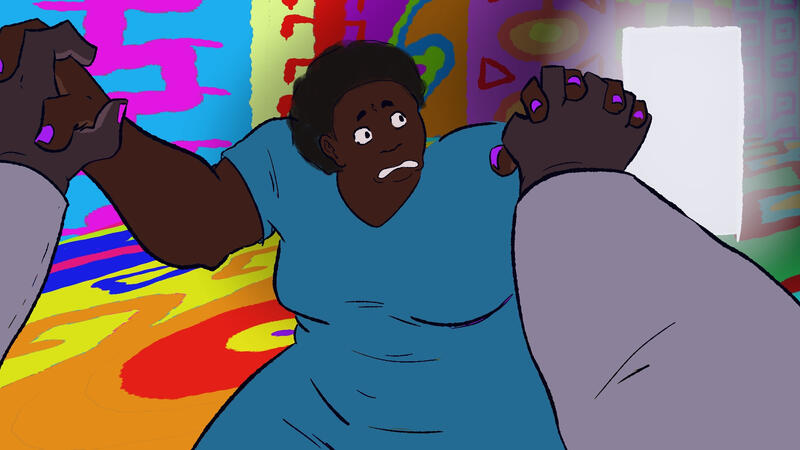
Beatboard Panel 5
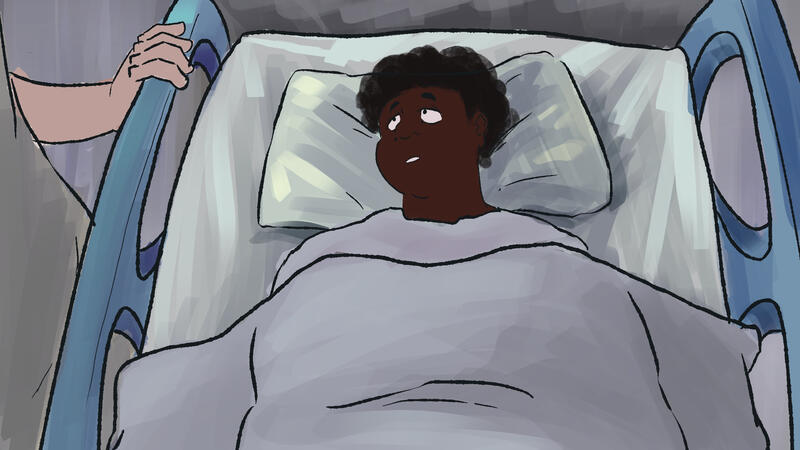
Beatboard Panel 6


Memento Mori (So Make The Most Of It!) is a capstone film by Axel Bennett for University of Central Florida's MFA Animation & VFX program and is slated to release publicly in 2027 following a film-circuit run in 2026.The story follows one human, only known as "Dead Human Walking," on their way to their third job as their boss pressures them to hurry up. They’re struck by a taco truck running a red light, who was speeding for their own economics-based reasons. After this, Dead Human Walking enters an In-Between Space where they meet a Grim Reaper named Red. Red desperately needs them to Move On into their Afterlife because she has quotas to fill, though she’s forbidden from telling them that.At first, she employs a customer-service persona trying to coax them into their Door to the Afterlife, but Dead Human Walking remains stubborn. After a peek at what their Afterlife could be, they decide they'd really rather not. This is the breaking point for Red, and she begins to fight them, trying to physically force them through the Door so she can move on to her next client.In the end, Dead Human walking defies death itself and returns to the World of the Living, determined to reclaim their life from their exploitative boss.The film draws inspiration from the psychedelia culture of the 1960's and 1970's as well as 1980's computer culture and 1990's-2000's indie comics like Johnny the Homicidal Maniac and Tank Girl.Memento Mori was purposefully made with non-subscription-based software to examine the capabilities of programs outside what is considered the industry standard. More about that is covered under Philosophical Elements.
Characters


Dead Human Walking
Dead Human Walking went through the most design iteration of the pair. Meant to be an everyman character, Dead Human Walking initially took after the everymen of years past, most specifically Neo from The Matrix. Initially an office worker, they were the stereotypical cisgender heterosexual white man, but it quickly became clear this wouldn't fit at all.An everyman is often the audience stand-in, a character meant to be so fundamentally human that everyone can relate to them. Historically, however, the Western everyman has most often been a white man, usually middle-class (with some exceptions), and any attempt to diversify this concept is seen as "forced."As a nonbinary person myself, the concept of the everyman aligning strictly with Western societal standards of who we are socially pressured to find relatable despite their experiences not reflecting the majority has grated at me for years. With Memento Mori I gave myself permission to buck that trend and put effort towards diversifying the concept of the everyman.Their final design was created to mirror Red's. Sharing a similar body type and both being darker-skinned Black individuals, Dead Human Walking serves as an example of what Red's Undeath could be, should she refuse the exploitation of her management.Their clothing, while simple, was designed carefully. Unlike Red, they are a freer individual, and so they wear only one layer; but, like Red, they have a tight schedule to keep, so this one layer is a simple sleeved dress they can pull on and dash out the door with. Their hair is styled in an afro, a natural style that would mostly take daily combing to keep in check, an activity they can do while on the bus or walking to work. It's important to note, though, that this is a distinctly Black style, only possible with their natural hair texture--another indication of their individuality and refusal to bend to exploitation.


Red Reaper
Red isa character I brought into the program with me, though she underwent drastic design changes from her inception to the final product.Red is, by nature, a shy and reserved person. The eldest daughter and heavily parentified, she takes on more responsibility than she needs to, and is constantly concerned with others' well-being over her own. She has a great deal of empathy and a tendency to make herself smaller for the convenience of those around her.Her job as a Grim Reaper is slowly robbing her of these qualities. The reservation and shyness has translated into insecurity and the empathy has made watching multiple deaths extremely hard for her. She's growing jaded in a way she hates, and that self-hatred has translated into external anger towards Dead Human Walking. She's envious that they've been given a choice to Move On in the first place.Grim Reapers are not made, they are recruited. Every death is a dice roll as to whether that person gets to Move On or if they have to take over for the Grim Reaper assigned to them. Red at first was extremely grateful for what she thought was a second chance at life, and she feels deceived by the fact it's closer to a lifelong sentence of servitude.Grim Reapers' bright hair colors are what marks them as Reapers, and subsumes their living names, rebranding them as property of Death itself. Their Undead traits can only be seen by their fellow Undead, but still, Red is very insecure about the color. As such she's dulled the rest of her wardrobe to try and compensate. Her insecurity and emotional restraint manifest as heavily layered clothing inspired by the work of Ann Somers Major, the costume designer for Hannah Montana in the early 2000's.Red believes she's healthily containing her emotions, and preventing others from having to deal with them. Unfortunately, all she's doing is choking herself. In Memento Mori, she reaches a breaking point, and her justified anger towards her situation unfortunately spills out towards Dead Human Walking.The initial draft of Memento Mori featured her mentor Blue more prominently, with the conflict in the film arising more from their differing opinions on how to handle the recently deceased. It was more straightforwardly a dark comedy, and as such, her design prioritized the ways in which she is softer and kinder than Blue, giving her a more "open" and friendly appearance with more emphasis on round, flowing shapes. Her final design, while still keeping her round shape, has more emphasis on triangular shapes hidden within as well, to hint at her repressed anger.


Environment


Initial Concept
The first conception of the film took place in a near-future urban area equally inspired by Minneapolis, the city in which I earned my undergraduate degree, and Across the Spider-Verse's interpretation of Spider-Gwen's world.With streaky paint textures rendered in Clip Studio Paint, the initial film was going to be entirely hand-drawn 2D animation and backgrounds, using Clip Studio Paint and ToonBoom Harmony.The city would begin with bright blues and yellows, shadowed with dark green and navy tones. Background characters would be partially obscured by the paint texture as if semi-transparent, while the main character's palette would be largely untouched. This was achieved by separating the background into multiple layers of semitransparent brush strokes, with a very sparse layer placed between the main character and background characters.The narrative followed an office worker struck and killed by a car on his way to work, after having tripped and fallen off the sidewalk. In his Afterlife, he met two Grim Reapers who seemed unable to agree on anything except the fact that his life was over and he needed to Move On into his Great Beyond. He would ultimately resign himself to his life not having been what he wanted it to be, and its moral was more of a cautionary tale than an uplifting one.The initial script was too long to be achieved in three years' time, and too complex and jumbled for the audience to grasp. The difficulty with Memento Mori was its existence as part of a pre-established world I had been cultivating since 2019; the film needed to serve as a short story within a collection, and did not need to encompass everything that might be covered in the entire series. It only needed to service as a pathway into that broader world, but my initial script was trying to cram all of the worldbuilding into 5 minutes.
Exploration: London Smog of 1952
As part of UCF's curriculum, we were instructed to explore 2 different alternative environments and time
periods for our film.The first I explored was the Great London Smog of 1952, an environmental disaster caused by the output of nearby factories. It blanketed London in smog for days on end. During this time, several people died, either due to getting lost navigating the city or being struck by motorists who couldn't see through the fog. Many more people would fall ill of varying long conditions post-exposure.This film was going to be still entirely hand-drawn, but with more of a mixed-media aspect; the backgrounds would be traditional charcoal and graphite, two mediums I have been using off and on since high school, while the animation would be composited on top of scans of these works in ToonBoom Harmony.The narrative would be very similar to the first: a man on his way to work, not allowed a day off even for the ecological disaster, struck and killed by a car on the way to work. The primary focus was still around Red and Blue's combative banter.This was the first foray into making Memento Mori a multimedia film, to reflect the broader multimedia nature of the entire world; Memento Mori was always planned to be a mixture of prose, comics, illustrations, and animations.
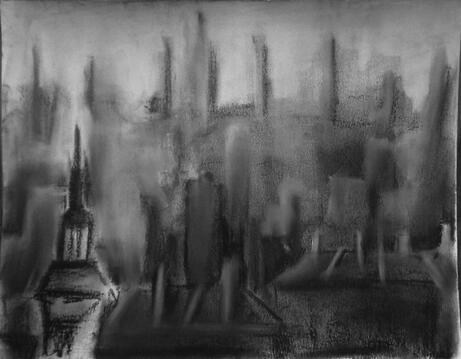
Smog background ideation - charcoal and graphite sketch
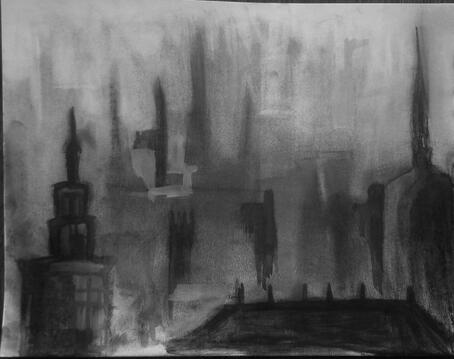
Smog background ideation - charcoal and graphite sketch
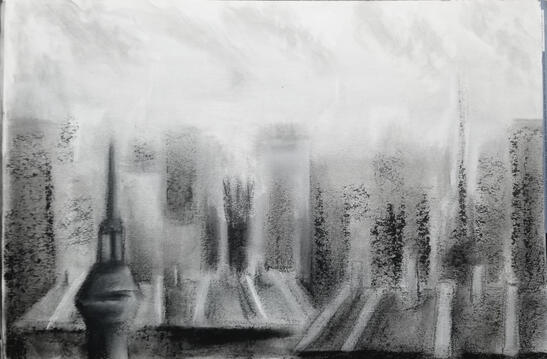
Smog background ideation - charcoal and graphite sketch
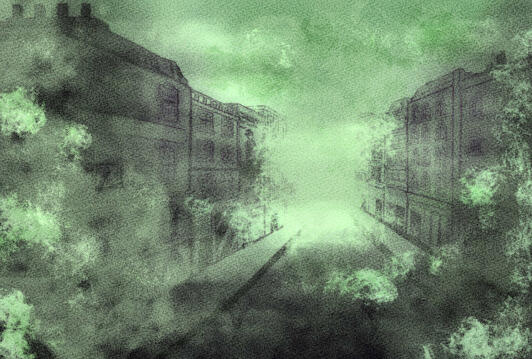
Smog background ideation - digital painting


Exploration: Psychedelic Desert
The second concept for Memento Mori was a contemporary psychedelic desert. Here I began to explore the concept of psychedelic imagery to display the out-of-body experience of near-death, as opposed to previous dark, gloomy interpretations of the Afterlife.I began to research the history of psychedelic art and the conventions of the genre both historical and modern, taking inspiration from artists of the original psychedelic movement like Alex Grey and Stanley Mouse but also from current psychedelic artists like Will Wood. Additionally, influence from the graphic novels of my youth began to present itself, and I employed coloring techniques taught to me by Brian Haberlin during my undergraduate. It was also loosely inspired by the novel Desert Solitaire, which I studied in high school.This narrative followed an office worker who had finally saved up enough vacation time to take their dream vacation: a week of camping in the desert. Unfortunately for them, they fell to their death while hiking along a thin trail. From there they would meet the two Grim Reapers--now two neon-toned vultures--and struggle to process their own death, upset at not being able to fully enjoy their vacation.One iteration of the concept had the desert clad in psychedelic colors and patterns the entire time, while in another I was entertaining the idea of a scrapbook appearance to the sand that would then be replaced by psychedelic patterns, while the rocky formations and sky would become an eerie grayscale.
Final: Cityscape
The final version of Memento Mori drew inspiration from all previous iterations while returning to the cityscape setting of the original concept. Influenced by the original painterly concept art, as well as the psychedelia and revisiting comic art conventions, and the study of corporate greed destroying innocent lives, Memento Mori became an anti-exploitation narrative fusing a wide variety of genres, as eclectic as human existence itself.The decision was made to switch from software I had difficulty justifying the price of outside of academic institutional support to free or one-time-purchase software; upon graduating from my undergraduate, I lost access to the Adobe suite as well as ToonBoom products and found myself less keen on the idea of paying $60/month in perpetuity just to continue doing things as I always had. I had purchased Clip Studio Paint as a PhotoShop alternative after getting tired of using MSPaint and Krita as alternatives, and was very pleased with its power. I specifically bought it while on sale for $50--a sale CSP runs every December--and decided to use this time to explore the free software available to me. The goal was to learn the power of software I could easily continue to use once I left UCF.This time the backgrounds would be 3D models, first with streaking painterly textures and then with psychedelic patterns projected upon them, drawn in Clip Studio Paint. The characters would be drawn with Blender's Greasepencil tool as 2D planes within a 3D environment. The film was first edited with ShotCut, then with DaVinci Resolve as needs changed.This time, the narrative followed a nonbinary retail worker (based on my own experience as a nonbinary retail worker) who is struck by a taco truck on their way to their third job.
Video Gallery: FX Tests
Building models created by Carolina Rapp